
I’ve been carrying this reflection since our trip to Memphis for The Organization for the Study of Communication, Language & Gender (OSCLG) Conference, letting it move through the busy swirl of everything in the weeks that came after. Life has refused to slow down, even as our work keeps inviting us to imagine another pace. Still, this story has been tugging at me with a quiet insistence, asking to be named.
After our presentation, our group visited the National Civil Rights Museum. The museum is a place I have known before, so I walked in with a sense of familiarity. I’ve been to many museums that hold our country’s deepest wounds: enslavement, Jim Crow, racial violence, and the long arc of the civil rights movement. I don’t take any of it for granted. But, I also didn’t expect to be undone by something new.
Near me was a woman from Africa, someone I had only recently met at the conference. I do not recall her specific country or tribe, only that our lineages recognize one another. She moved slowly through the exhibit, her whole body bowed by grief that rose up without permission. At one point she wept openly, clearly overwhelmed with grief.
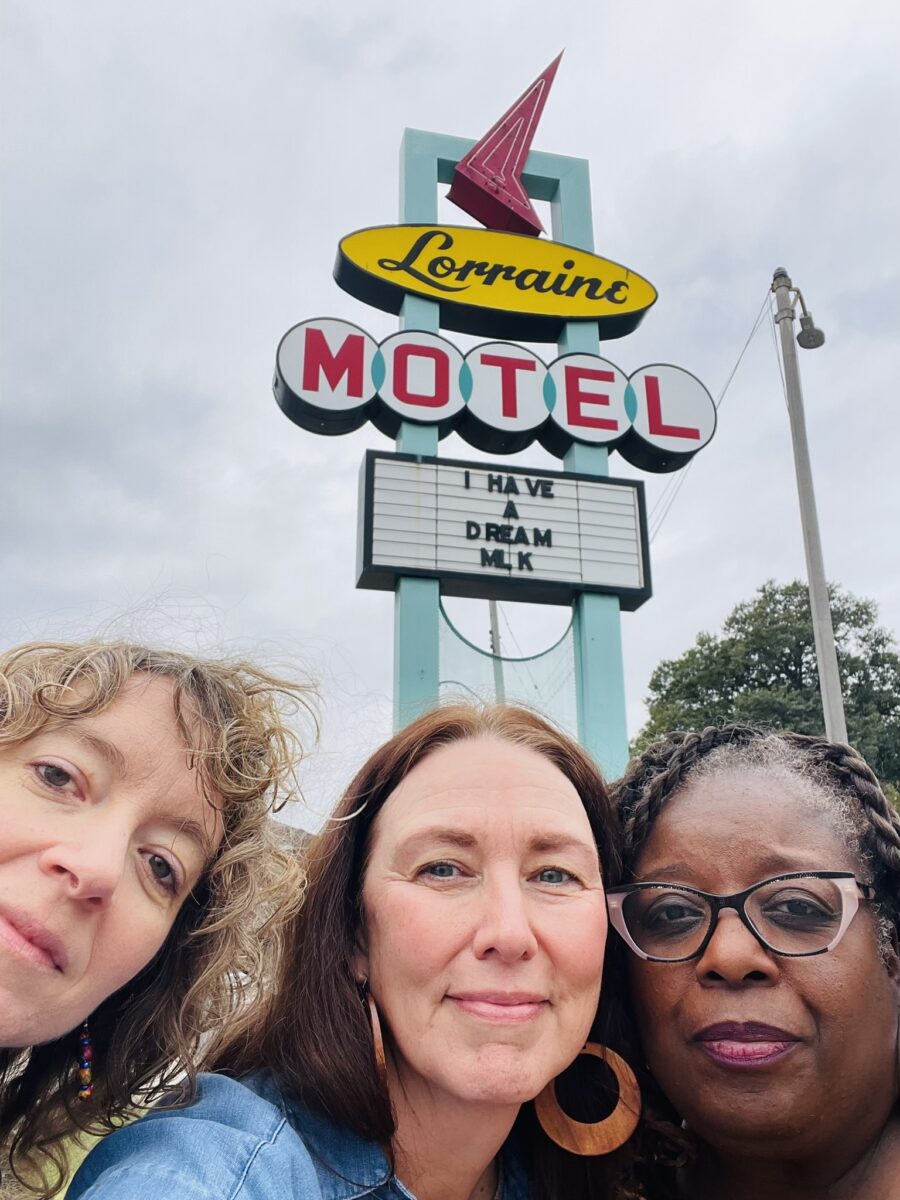
And something inside me shifted.
I realized, with a force that stunned me, that she stands on the other side of the same wound I carry. The ancestors torn from her continent are the same ancestors who birthed mine. I know what it means to be descended from enslaved people in this country. I’ve reckoned with that history for years. But I had never personally acknowledged someone who holds the other end of that story. And I had not considered how our reckonings differ.
She was meeting this history in an unfiltered, unavoidable way. While the horrors of slavery have shaped every part of my life, they have also become familiar terrain. She was encountering it as something unfamiliar.
There was a kinship that rose between us, quiet and unspoken. I kept glancing toward her, wanting to hold space without intruding. At one point, I sat with her and simply said, “I’m here for you.” I also understood that she needed to walk this path on her own terms.
I’m still wrestling with why this moment felt so profound. Maybe it’s because Memphis sharpened something I’ve been feeling for a long time: the gap between how we talk about slow leadership and how we actually live it, especially in a country that is fighting over its own memory. We are navigating an era where the history of enslaved Africans is being diluted, denied, or rewritten. The speed of the political moment pushes us toward reaction instead of reflection, toward defensiveness instead of depth.
And yet slow leadership asks something different. It invites us to move at the pace of relationship, even when the truth is heavy. It asks for presence in the places that make us uncomfortable. It calls us toward courage—the kind that lets us tell our stories honestly and create conditions where our full humanity can be acknowledged.
Memphis reminded me that courage is not a quick jolt of emotion; it is spaciousness. It is staying open long enough to witness someone else’s grief without running from your own. It is allowing an unexpected moment of connection to rearrange something you thought you had already understood. It is recognizing that leadership isn’t just how we guide others, it’s also how we allow ourselves to be touched, changed, and expanded.
As I continue to make meaning of this experience, I find myself returning to one question: How do we cultivate the courage required for slow leadership to take root in a world that keeps pulling us toward speed, avoidance, and erasure?
I don’t have a full answer yet. But I believe courage grows in the same soil that nourishes all slow practices: attentive presence, relational grounding, and a willingness to wrestle with truths that shape us –whether we are ready for them, or not.
Memphis gave us the gift of seeing ourselves, and each other, through a wider lens. That feels worth lingering with. And maybe that lingering is its own kind of courage.