
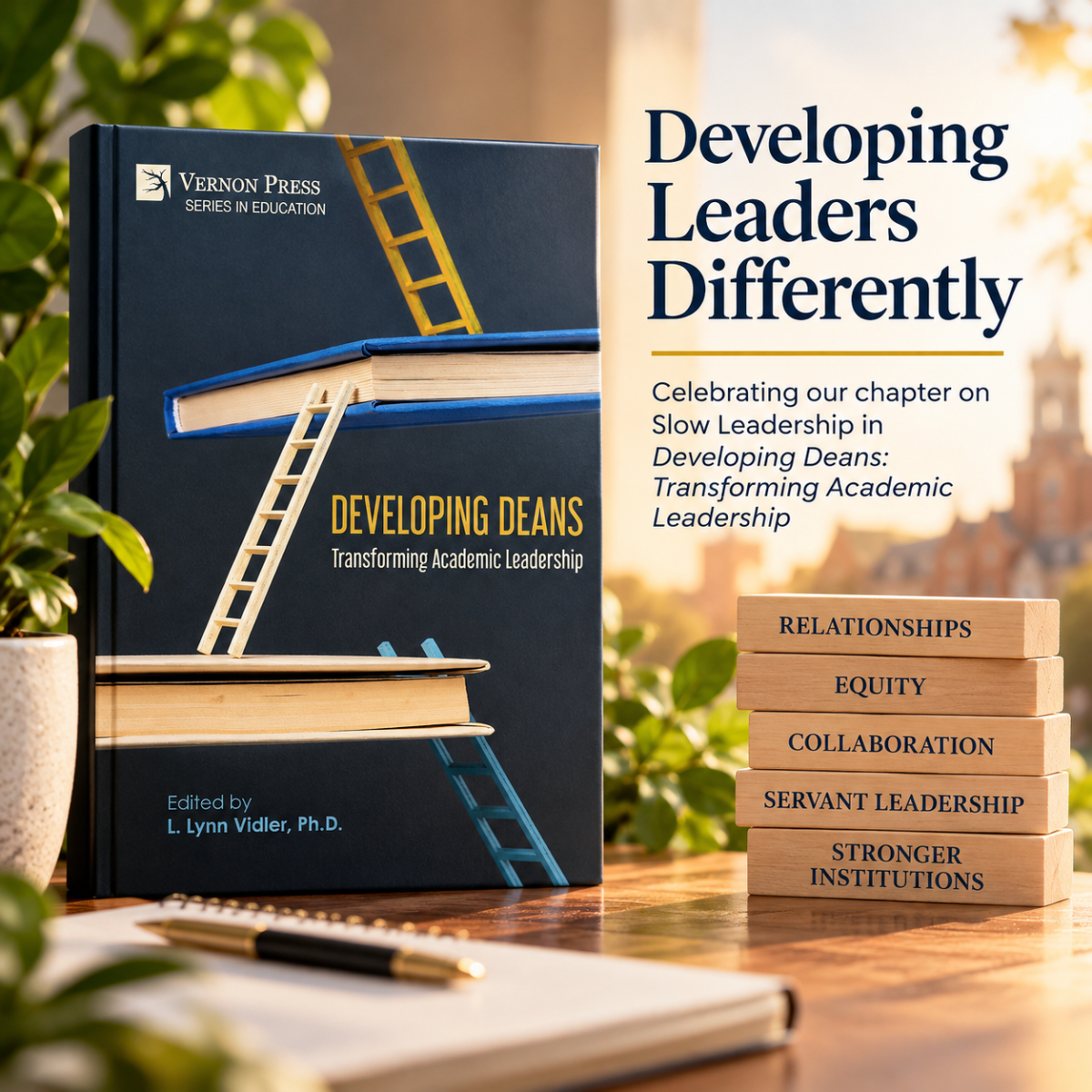
We are delighted to celebrate the publication of our chapter, “Leveraging Slow Leadership to Develop Deans,” in Developing Deans: Transforming Academic Leadership, edited by L. Lynn Vidler and published by Vernon Press earlier this year. For my colleagues Rachel Epp Buller, Christine E. Crouse-Dick, and me, this represents another meaningful step in our ongoing exploration of Slow Leadership and its possibilities for transforming higher education.
At its heart, Slow Leadership challenges us to reconsider what effective leadership looks like. Too often, leadership is associated with authority, efficiency, and top-down decision-making. But what if we developed leaders who prioritized relationships, shared power, listened deeply, and created environments where people and communities could thrive?
What excites me about this collection is the opportunity to engage with other scholars who are asking similar questions. Nicole R. Stokes’s work on equity-minded leadership, Jennifer Woolard and Ken D. Elston’s exploration of relational leadership, and contributions on shared governance and collaboration all resonate with our understanding of leadership as something rooted in relationships, responsibility, and care.
These ideas also intersect deeply with my work in restorative justice, belonging, and institutional transformation. I have long believed that the quality of our relationships shapes the quality of our institutions. Slow Leadership invites us to examine how we exercise power, whose voices are heard, and how we cultivate trust and shared responsibility. It is not simply about doing things more slowly, but about being more intentional in how we lead and engage with one another.
I believe we need much more conversation about how we prepare deans and other academic leaders to move beyond traditional hierarchical models toward approaches grounded in service, equity, collaboration, and community. Academic expertise alone does not prepare someone to lead people. We must be intentional about developing leaders who understand that their responsibility extends beyond managing institutions to creating conditions where others can flourish.
As we approach the book’s first anniversary, we are grateful to be part of this thoughtful collection and excited about what lies ahead. There is much more we hope to learn from and alongside these remarkable contributors, and many more conversations we hope to have about what leadership can become.
For now, we are celebrating this milestone, sharing our work, and looking forward to the possibilities ahead. We believe that changing how we develop leaders can ultimately change the institutions they lead.
Perhaps the question is not simply how we develop better leaders, but how we develop leaders who help us become better communities.
That is a conversation worth continuing.